Village history

Twelve thousand years on one green

Flint tools, Roman farms, a Domesday entry, a silent squire, eight windmills, Impressionist painters — and the roar of American jets over the water meadows. Finchingfield has more history per acre than almost any village in England.

Origins

Before there was a village

Hunters, farmers & Romans

People have lived on this land far longer than there has been a Finchingfield. The oldest object ever found in the parish is a flint tool roughly 12,000 years old, and the finest is a polished Neolithic axe head. Two Roman settlements have been excavated locally — one thought to be a villa a few hundred metres from where the church now stands — yielding tiles, pottery, oyster shells and a bee-hive quern for grinding corn dated to around AD 50–150.

Finc’s people give it a name

Around AD 500 the Saxons founded the Kingdom of the East Saxons — Essex — and gave the place its name. In Saxon records it appears as Phincingefelda: “the open land of Finc’s people.” The village has carried some version of that name for fifteen centuries, through Danes, Normans and every age since.

Timeline

A thousand recorded years

Domesday 1086

One of the larger villages in England

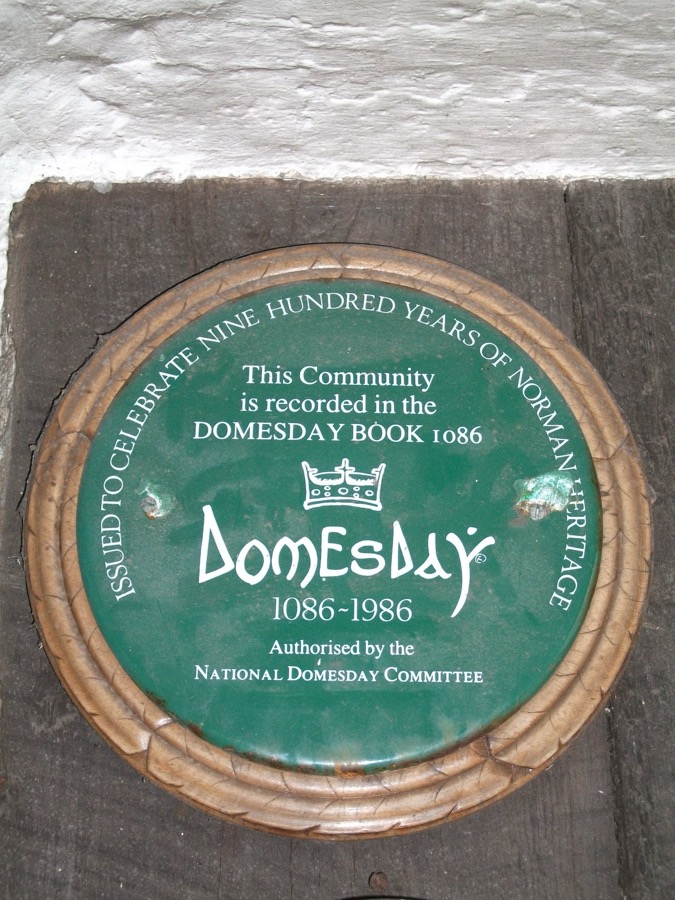
William the Conqueror’s great survey records Finchingfield with 124 households — among the largest fifth of all settlements in the Domesday Book. Before the Conquest the land belonged to Earl Aelfgar and other Anglo-Saxons; afterwards it passed to Norman lords including King William himself, Count Eustace of Boulogne, Count Alan of Brittany and Hervy de Ispania — whose name survives, nine centuries on, in Spains Hall.

Norman c. 1170

The church tower rises

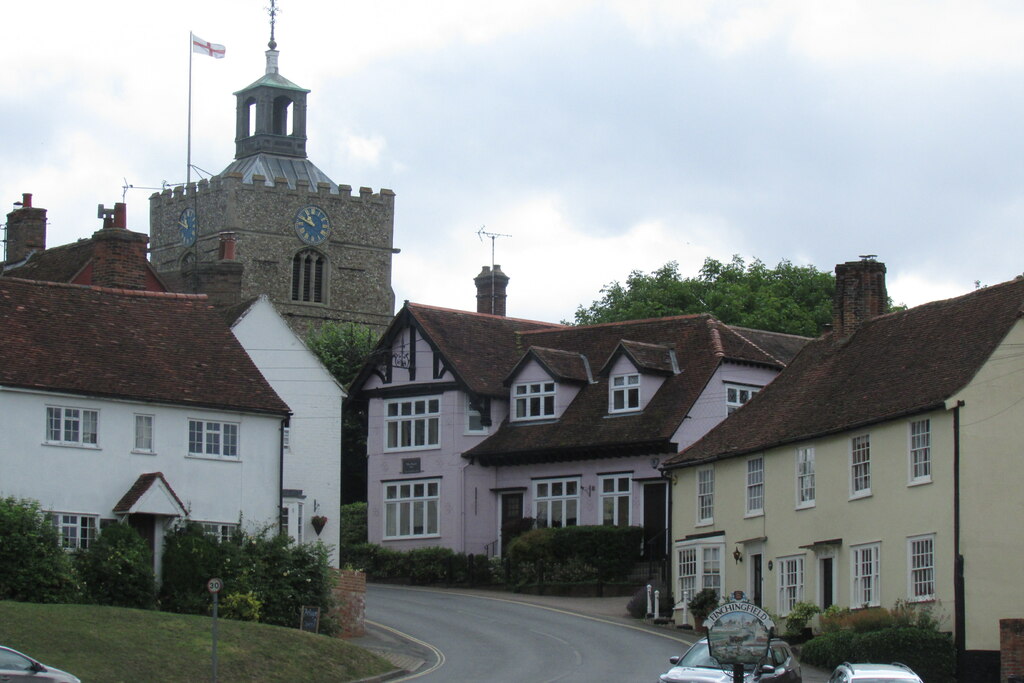
The great Norman tower of St John the Baptist went up around 1170, with 13th- and 14th-century additions following. It still crowns the village skyline, and the climb up Church Hill past the cottages remains the classic Finchingfield view in reverse.

Medieval c. 1470

The Guildhall

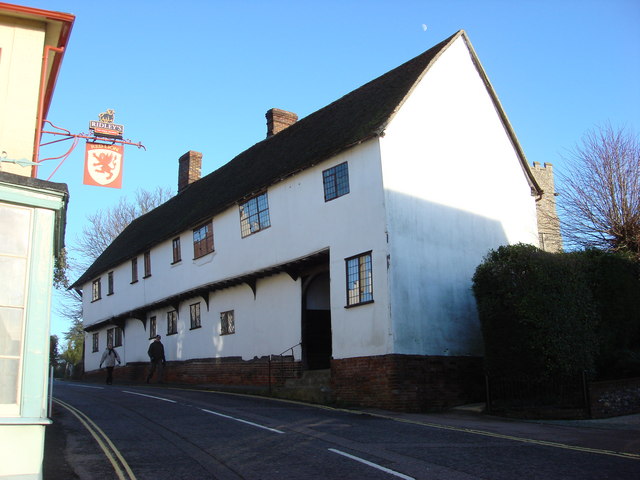
Beside the churchyard gate, the Guild of the Holy Trinity built its timber-framed Guildhall — a priest’s lodging above, shops and workshops below, and a great hall for guild meetings. Over five and a half centuries it has served as schoolhouse, almshouse and parish meeting place; today it holds the village museum and library, still doing the job it was built for.

Elizabethan 1585

Spains Hall rebuilt in brick

The moated manor founded by Hervy de Ispania was rebuilt as the handsome Elizabethan brick house that stands today, home to the Kempe family and later to Samuel Ruggles and the Ruggles-Brise family, whose descendants held it into the modern era.

Legend 1620s

The silent squire of Spains Hall

Finchingfield’s strangest story: squire William Kempe, mortified after wrongly accusing his wife of infidelity in a fit of temper, vowed to never speak again for seven years. Local tradition says he dug a pond in the grounds of Spains Hall for each silent year — seven in all — and kept his vow through his wife’s death and even a robbery at the Hall. He died in 1628, and a memorial tablet in the parish church still records his penance.

Georgian c. 1756

Eight windmills at work

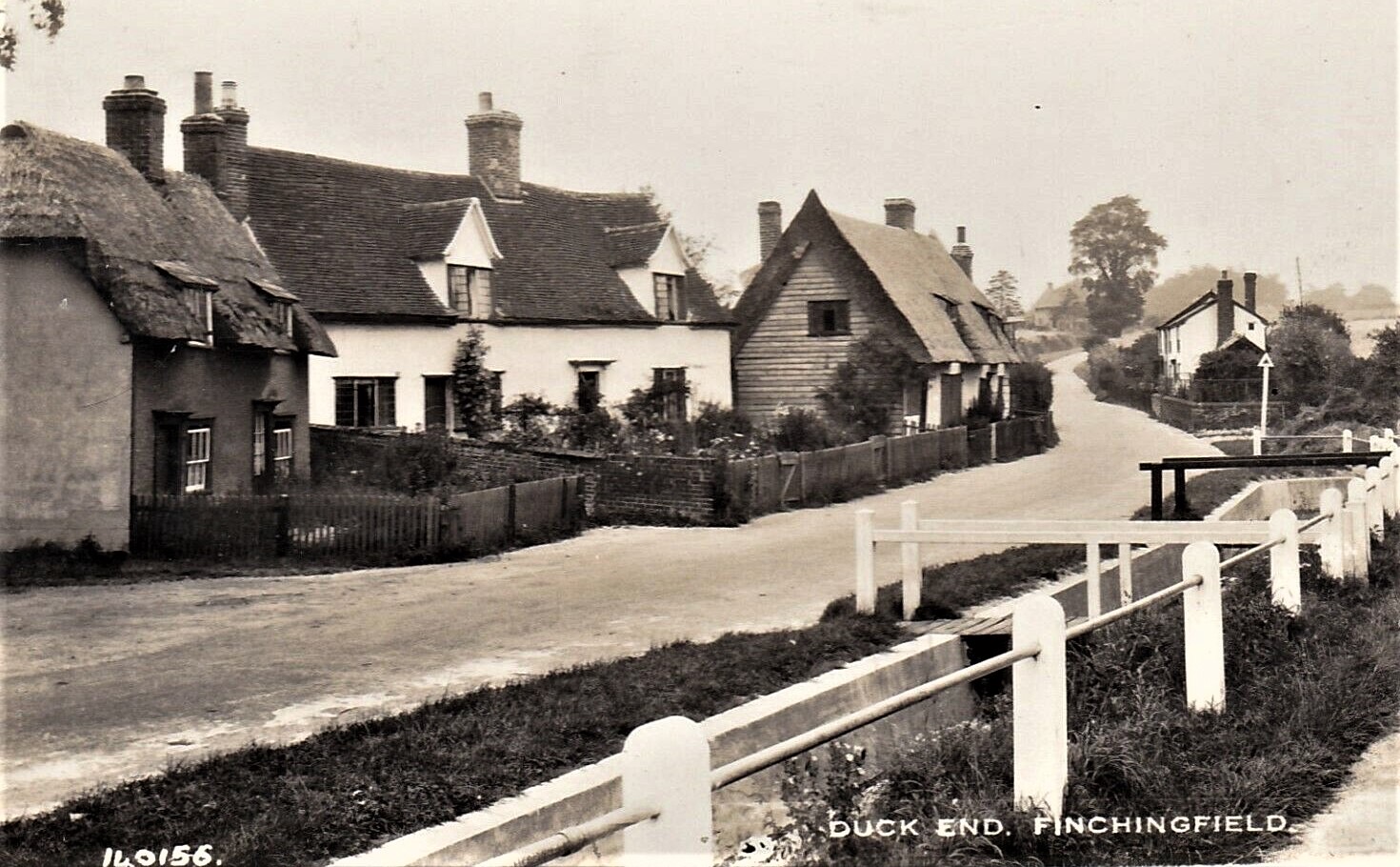
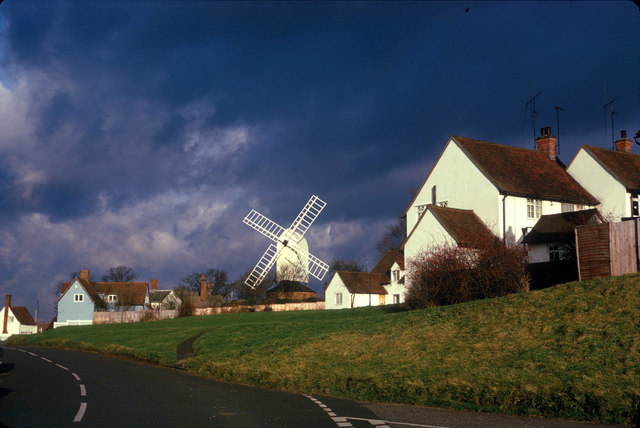
At its height the parish turned eight windmills. The survivor at Duck End — the little white post mill in the famous view, built around 1756 — is said to be both the oldest windmill left in Essex and the smallest of its kind. It ground corn until about 1890, and is Grade II listed and lovingly preserved, opening to visitors through the summer.

Victorian 1851

A working village of 2,594 people

The 1851 census counted 2,594 residents — roughly twice today’s parish. Alongside farming, straw plaiting for the hat trade was a vital cottage industry for women and children. As late as 1922 the village directory listed a doctor, a thatcher, two blacksmiths, five pubs and six grocers.

Edwardian 1905

The painters arrive

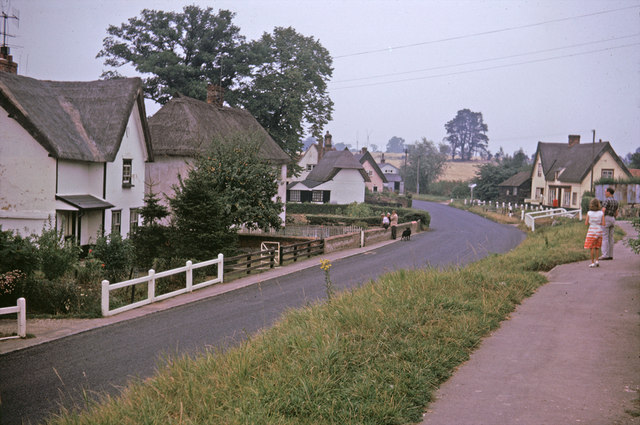
Lucien Pissarro — son of the French Impressionist Camille Pissarro — came to paint Finchingfield in 1904 and returned in 1905, producing oils including Grey Weather, Finchingfield, now in Southampton City Art Gallery. Generations of artists and photographers followed, putting the green, pond and bridge on calendars, jigsaws and chocolate boxes until Finchingfield became known as “the most photographed village in England.”

Literary 1900s

Dodie Smith and the Pepper Pot

The hexagonal thatched Round House — the “Pepper Pot,” built in the 18th century — is locally associated with Dodie Smith, author of The Hundred and One Dalmatians, who lived and wrote at The Barretts in the parish until her death in 1990. It’s a favourite stop on any walk through the village lanes.

Television 1986

Lovejoy comes to the green

When the BBC filmed its much-loved antiques drama Lovejoy (1986–1994) across North Essex and Suffolk, Finchingfield became one of its favourite locations — the village appears in several episodes, and The Fox on the green features in the 1992 Christmas special. Fans still trace the locations today.

Rewilding 2019

The beavers come back to Spains Hall

Nine centuries after Hervy de Ispania, his estate made history again: in March 2019 a pair of Eurasian beavers was released at Spains Hall — the first in Essex for more than 400 years — as a natural flood-management scheme with the Environment Agency to protect the village below. The pair has grown into a thriving family whose dams now hold back millions of litres of floodwater.

Crowned 2026

Named Essex’s prettiest village

Nine hundred and forty years after Domesday, the village collected its latest honours: Essex Live and Love Exploring named it Essex’s prettiest village — ahead of Dedham and Thaxted — and Condé Nast Traveller featured it the same year among the prettiest villages within reach of London. The photographers, it turns out, were right all along.

The American connection

Two Wethersfields, one story

Finchingfield’s neighbouring village of Wethersfield, two miles down the road, ties this corner of Essex to America twice over — once in the age of sail, and again in the age of the jet.

1634 — Wethersfield, Connecticut

During the Great Migration, Puritan settlers from East Anglia crossed the Atlantic and planted a town on the Connecticut River. First called Watertown, in 1637 they renamed it Wethersfield after the Essex village where many of them had roots — and it stands today as the oldest permanent English settlement in Connecticut, proudly styled “Ye Most Auncient Towne.” American visitors tracing New England ancestry still find their way back to these North Essex lanes, where the family names on old gravestones echo the founding rolls of colonial towns.

1944 — Station 170

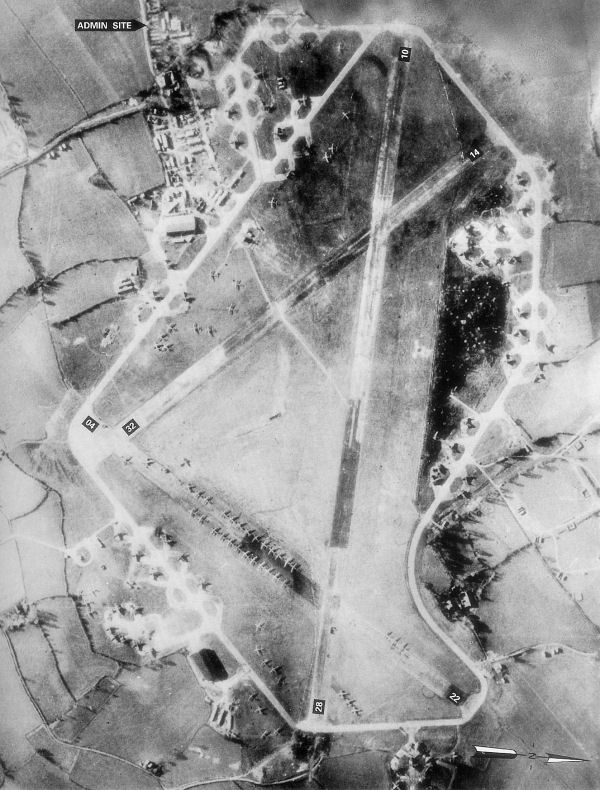
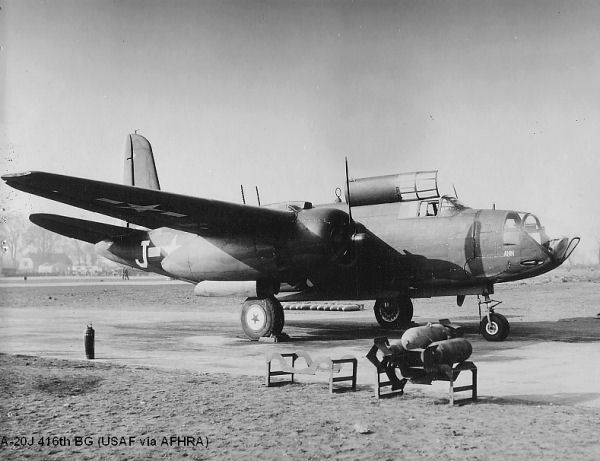
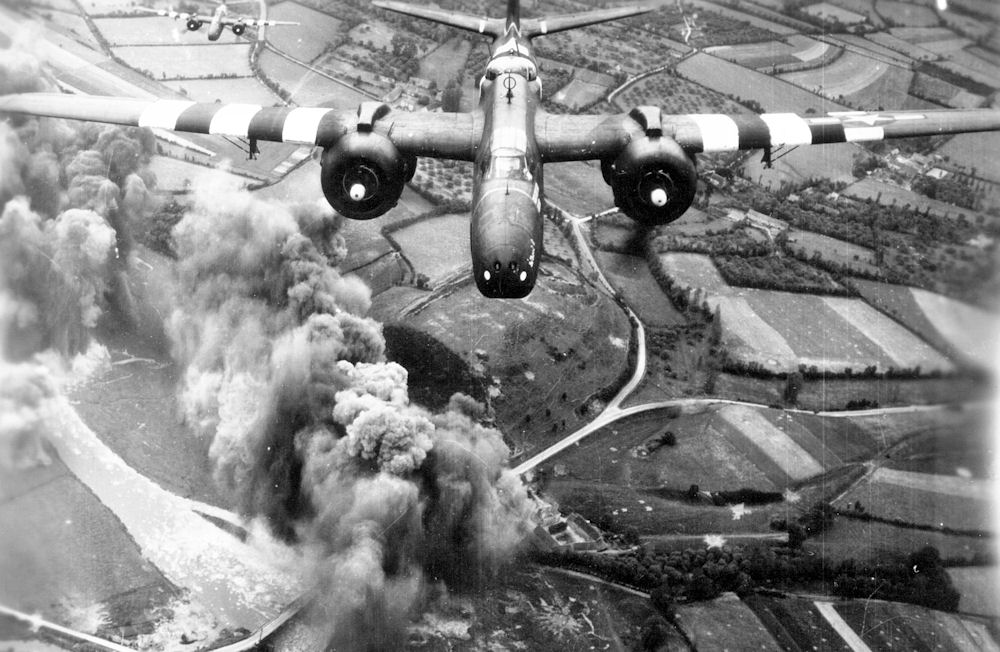
Three centuries later, America came to Wethersfield. The wartime airfield built in the fields between the two villages — RAF Wethersfield, USAAF Station 170 — received the 416th Bombardment Group in early 1944. Its A-20 Havocs flew the first of 140 missions on 3 March 1944, striking V-weapon sites, airfields and coastal defences, then bridges and railways in direct support of D-Day, before the group followed the front line to France that September. RAF Stirling squadrons flying secret supply drops to the resistance came next, and in March 1945 the C-47s of the 316th Troop Carrier Group left Wethersfield for Operation Varsity, the great Rhine crossing.

A-20 Havoc bombers of the 416th Bombardment Group in D-Day invasion stripes, 1944
A-20 Havocs of the 416th Bomb Group wearing D-Day invasion stripes, summer 1944. (US Army Air Forces)
F-100 Super Sabre of the 20th Tactical Fighter Wing at RAF Wethersfield, 1966
A 20th Tactical Fighter Wing F-100 Super Sabre at Wethersfield, June 1966. (US Air Force)

1952–1970 — the Super Sabre years

With the Cold War hardening, the US Air Force returned in 1952. The 20th Fighter-Bomber Wing — squadrons 55th, 77th and 79th — made Wethersfield home for nearly two decades, flying F-84 Thunderjets and, from 1957, the supersonic F-100 Super Sabre. For a generation of Finchingfield villagers the sight and sound of American jets over the green was simply part of life, and thousands of airmen and their families became part of the village’s own story — in its pubs, its churches and more than a few of its marriages.

The wing moved to Upper Heyford in 1970. Wethersfield served on as a standby base — home to the USAF’s 819th RED HORSE engineers — until the last Americans handed it back on 3 July 1990. The site is now used by the Ministry of Defence, and a volunteer-run Wethersfield Airfield Museum keeps the memory, welcoming veterans and their families back to the old field.

Notable people

Famous names of Finchingfield

For a village of a thousand souls, Finchingfield has produced — and attracted — a remarkable cast: two Olympic champions, a firebrand preacher, a suffragette, a prison reformer, beloved authors and one of Britain’s best-known chefs.

Olympian Gold, 2021

Beth Shriever

Raised in Finchingfield, Shriever became the first British rider ever to win Olympic BMX racing gold, storming to victory at the Tokyo Games. When funding for female riders was cut she crowdfunded her own road to Tokyo while working as a teaching assistant — one of British sport’s great underdog stories, begun on these lanes.

Chef Present day

Jamie Oliver

Britain’s best-known chef is the current owner of Spains Hall, where he lives with his wife Jools and their family — putting a household name at the head of the estate founded by Hervy de Ispania nine centuries ago, and behind its pioneering beaver project.

Author

Dodie Smith

The author of The Hundred and One Dalmatians and I Capture the Castle lived at The Barretts in Howe Street, in the parish, until her death in 1990 — and is buried here. The “Pepper Pot” Round House is a favourite stop for her readers.

Author

Norman Lewis

Called one of the greatest travel writers of the 20th century — Naples ’44, Voices of the Old Sea — Lewis lived and wrote in Finchingfield. His 1969 reporting on Brazil led him to help found the tribal-rights charity Survival International.

Olympian Gold, 1920

Harry Stiff

Olympic champion — gold in the tug of war at the Antwerp Games of 1920 with the City of London Police team. He later swapped the rope for the pumps as landlord of the Horse & Groom at Cornish Hall End, in the parish.

Suffragette

Janie Terrero

Born in Finchingfield in 1858, Terrero became a militant suffragette — imprisoned and force-fed in Holloway in 1912 for the cause of votes for women. The handkerchief she embroidered for her fellow hunger strikers is now a treasured museum piece.

Preacher 1629–1651

Stephen Marshall

Vicar of Finchingfield for over twenty years — and the most influential preacher of the English Civil War, said to sway Parliament more than Archbishop Laud swayed the King. Stephen Marshall Avenue in the village carries his name.

Author

A. J. A. Symons

Biographer, bibliophile and co-founder of the Wine & Food Society, Symons made his home at Brick House in the village. His The Quest for Corvo (1934) is still hailed as one of the most original biographies ever written.

Legend d. 1628

William Kempe

The “silent squire” of Spains Hall, who vowed seven years of silence in penance for a false accusation against his wife — and, legend says, dug a pond for every mute year. His memorial tablet is still in the parish church.

Painter

Lucien Pissarro

Son of the Impressionist Camille Pissarro, Lucien came from London to paint Finchingfield in 1904 and 1905 — Grey Weather, Finchingfield hangs in Southampton City Art Gallery — helping begin the village’s fame as a painters’ and photographers’ favourite.

Reformer

Sir Evelyn Ruggles-Brise

Born at Spains Hall in 1857, he transformed British justice as founder of the Borstal system — the idea that young offenders should be trained and educated rather than simply locked away — during his quarter-century leading the Prison Commission.

Also of the parish

The village also gave the world Georgian landscape engraver John Browne (born 1742), eminent Victorian surgeon Edmund Owen, New Zealand first-class cricketer Basil Totman, and Major-General Sir Harold Ruggles-Brise of Spains Hall, who commanded a Guards brigade in the First World War.

Then & now

From the album

Historic photographs via Wikimedia Commons — wartime and Cold War images are US and British government works in the public domain; others as credited. Full attribution on the photo credits page.

See it for yourself

The Guildhall museum, the Kempe tablet in St John’s, the post mill and the war memorial on the green are all an easy stroll apart — and the Wethersfield Airfield Museum is a short drive. Most sites open seasonally, so check what’s on before you travel.

Walk through it all in an afternoon

Every chapter of this story is still standing. Plan your visit and see a thousand years in a single stroll.

Plan a visit